Author: Adrian Gatton

  • How to Rob a Bank (Part 2, Channel 4)

    How to Rob a Bank (Part 2, Channel 4)

    How to Rob a Bank (Part 2)
    Channel 4
    17 March 2003

    A carefully researched, two-part series exploring the history of organised crime and armed robbery, in particular the “golden age” of “across the pavement artists” who flourished in the 1960s and 1970s.

    When British banks and their security advisors developed the burglar-proof safe in the 1950s, they unwittingly created the era of the organised bank robber. How To Rob A Bank tells the story of the tit-for-tat war of technology and psychology that followed.

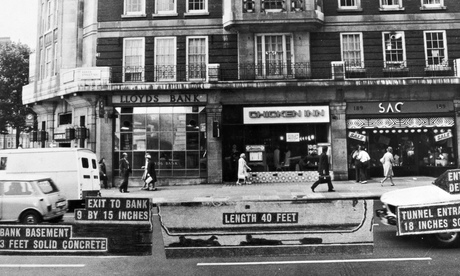
    The 1960s saw the birth of the “project crime” – sophisticated and increasingly violent attacks on the banks, their staff and their money. We trace the robbers’ pursuit of cash from safe-cracking through to hold-ups in the banking halls and the military-like assaults on cash in transit. The banks fought back, turning each branch into a fortress and protecting their staff with screens and cameras. Sometimes this made things worse – one cashier was killed by flying fragments of the security glass meant to protect her. But the cameras did the trick – as the first man ever arrested on the evidence of a British bank camera recalls.

    As the banks developed better ways of deterring professional robbers from targeting their branches, the villains instead perfected their assaults on cash in transit trucks. Bernie Kahn, of the Chainsaw Gang, tells how his men defied the banks by attacking an armoured van with specialist cutting gear. The van makers fought back, inventing airlocks and interlocking doors which further delayed the villains’ getting their hands on the loot. Other inventions tried to render the cash too difficult to steal – from octopus arms which shot out of the cash bag making it hard to carry (a flop) to armoured bags which ruined cash by dyeing it red when tampered with (a great success).

    In the end, though, it was intelligence-led policing and the willingness of the police to fight fire with fire by arming officers which had a profound effect on the career criminals’ desire to keep attacking the banks’ money.

    The programmes include interviews with police, villains, security specialists and the inventors who pioneered new security systems.

    Associate Producers: Adrian Gatton; James Oliver
    Series Consultant: Paul Lashmar
    Director: Jonathan Jones
    Exec Producers: Steve Boulton

  • Spearmint Rhino dances to £1.75m (Evening Standard)

    Spearmint Rhino dances to £1.75m
    By Jonathan Prynn and Adrian Gatton
    Evening Standard
    14th March, 2003
    Club makes profits of £3 a minute …

  • How to Rob a Bank (Part 1, Channel 4)

    How to Rob a Bank (Part 1, Channel 4)

    How to Rob a Bank (Part 1)
    Channel 4
    10 March 2003

    A carefully researched, two-part series exploring the history of organised crime and armed robbery, in particular the “golden age” of “across the pavement artists” who flourished in the 1960s and 1970s.

    When British banks and their security advisors developed the burglar-proof safe in the 1950s, they unwittingly created the era of the organised bank robber. How To Rob A Bank tells the story of the tit-for-tat war of technology and psychology that followed.

    The 1960s saw the birth of the “project crime” – sophisticated and increasingly violent attacks on the banks, their staff and their money. We trace the robbers’ pursuit of cash from safe-cracking through to hold-ups in the banking halls and the military-like assaults on cash in transit. The banks fought back, turning each branch into a fortress and protecting their staff with screens and cameras. Sometimes this made things worse – one cashier was killed by flying fragments of the security glass meant to protect her. But the cameras did the trick – as the first man ever arrested on the evidence of a British bank camera recalls.

    As the banks developed better ways of deterring professional robbers from targeting their branches, the villains instead perfected their assaults on cash in transit trucks. Bernie Kahn, of the Chainsaw Gang, tells how his men defied the banks by attacking an armoured van with specialist cutting gear. The van makers fought back, inventing airlocks and interlocking doors which further delayed the villains’ getting their hands on the loot. Other inventions tried to render the cash too difficult to steal – from octopus arms which shot out of the cash bag making it hard to carry (a flop) to armoured bags which ruined cash by dyeing it red when tampered with (a great success).

    In the end, though, it was intelligence-led policing and the willingness of the police to fight fire with fire by arming officers which had a profound effect on the career criminals’ desire to keep attacking the banks’ money.

    Associate Producers: Adrian Gatton; James Oliver
    Series Consultant: Paul Lashmar
    Director: Jonathan Jones
    Exec Producers: Steve Boulton

  • Mark Thomas: Weapons Inspector (Channel 4)

    Mark Thomas: Weapons Inspector (Channel 4)

    Mark Thomas: Weapons Inspector
    Channel 4
    January 31, 2003

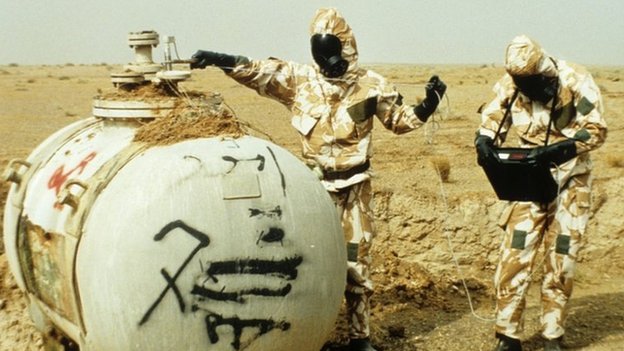
    With America and Britain pushing the UN to put Hans Blix’s weapons inspection team into Iraq, Mark Thomas forms a citizen’s weapon inspectors team in order to examine the performance of the two super powers. Starting with Buckingham Palace the group go round a lab in America making anthrax, a nuclear submarine base and a military weapons store just off the M4.

    Director: Stephen Rankin
    Producer: Nick Hayes
    Assistant Producer: Adrian Gatton
    Executive Producer: Stephen Phelps


  • Westminster V Larry Flynt (Evening Standard)

    Westminster V Larry Flynt
    By Adrian Gatton and Danielle Demetriou
    Evening Standard
    14th November 2002
    Anyone who thought London had reached saturation point in terms of lap-dancing joints had better think again. The biggest porn magnate in the world, Larry Flynt, has declared war by unveiling plans to open his first table-dancing club in Britain next year. ..read

  • A Gangland Killing, Lap Dancers Who Are Said to Sell Sex and the Criminal Past of … (Evening Standard)

    A Gangland Killing, Lap Dancers Who Are Said to Sell Sex and the Criminal Past of … (Evening Standard)

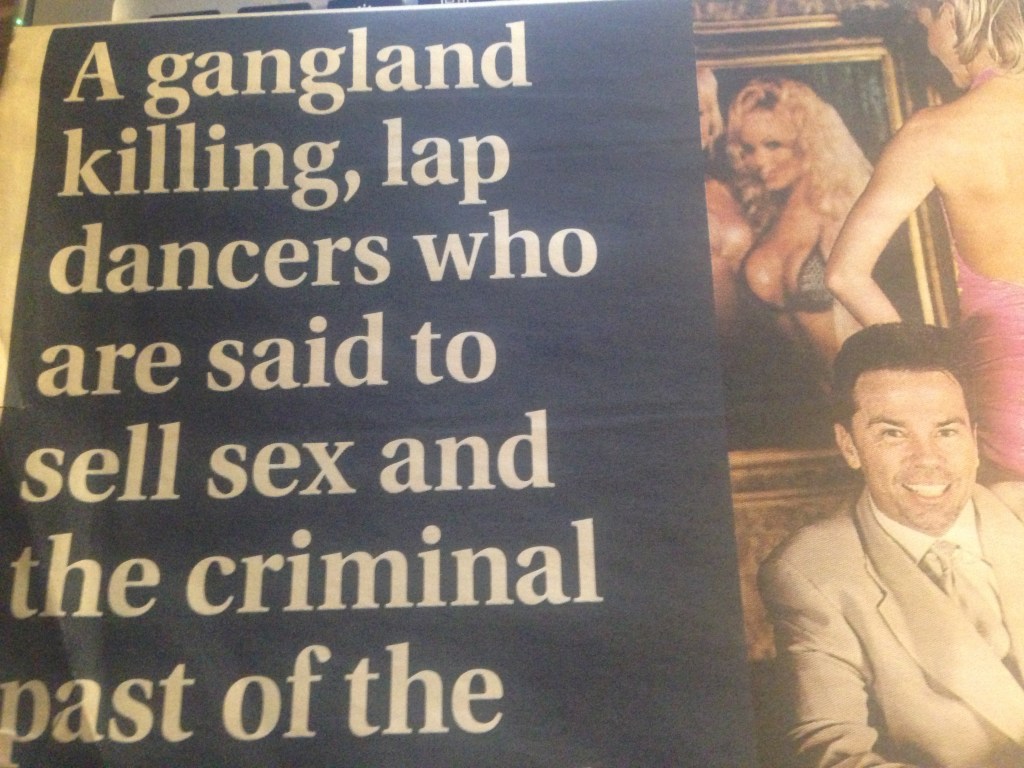
    A gangland killing, lap dancers who are said to sell sex and the criminal past of the man behind the Spearmint Rhino empire – A Standard investigation reveals the bizarre background to today’s legal battle to strip a lap-dancing club of its licence.
    By Chris Blackhurst and Adrian Gatton
    Evenening Standard
    16 September 2002

    ON 21 August last year, Stuart Cadwell, boss of Spearmint Rhino UK, the country’s biggest chain of lap-dancing clubs, left the company’s Tottenham Court Road branch and headed home. It was 2am as he walked to a nearby car park. Suddenly, he was the victim of an attack which was vicious even by the standards of central London’s increasingly mean streets at that time in the morning.

    Two men came up behind, struck him on the head with a machete and knocked Mr Cadwell to the ground. He somehow fought back but was stabbed at least twice, one blow puncturing a lung. “He managed to crawl about 250 yards back to the club,” said Max Clifford, Spearmint Rhino’s publicist. Mr Cadwell was lucky: he was rushed to hospital and lived. His assailants made off with just £60.

    A year later, nobody has been charged for the crime. Another victim of an unprovoked assault?

    The police don’t think so. They suspect this was no ordinary street robbery, that Mr Cadwell was targeted by associates of a notorious north London crime family in a feud with his company.

    For Mr Cadwell, having to deal with police questions was not a new experience. In September 1990, a woman was taking a ride with him in his helicopter in California.

    Macy Rahgozar, 21, was the girlfriend of David Amos, a close friend of Mr Cadwell. She stepped out of the helicopter as it stood on the tarmac at Long Beach Airport to greet Mr Amos, who was waiting for her, and walked into the still turning tail rotor blades. Ms Rahgozar suffered massive head injuries and died.

    A police investigation concluded the death was an accident.

    Last year, Mr Amos was convicted of the m a c h i n e – g u n killing of a strip club boss in Los Angeles in 1989 – the year before the helicopter tragedy – and jailed. Mr Amos, who was close to a member of the Bonanno mafia family in New York, had paid a hitman to shoot Horace McKenna at his home.

    Welcome to the seedy underbelly of Spearmint Rhino.

    Since its arrival here, in 2000, Spearmint Rhino has become a magnet for businessmen entertaining clients or wanting to unwind after work. They flock to what the club advertises as its clean, ” look-but-don’t-touch” venues, where attractive nude girls dance round poles for them in the middle of the floor, or up close at their table, or more intimately still, in private back rooms.

    The company now has seven clubs in the UK, three in London, two in Birmingham and in Harrogate and Bournemouth, and claims to be aiming for 100.

    Vauxhall in London and Sheffield are due to open shortly. Holborn, in London, is also on the company’s list. Ultimately it wants to acquire public respectability by listing on the London Stock Exchange.

    Spearmint Rhino’s owner is John Gray, 45. Well-groomed, with a carefully-coiffured hairstyle, Mr Gray is a hustling Californian who mixes easily with his highflying City clientele. He is richer than most of them, having made a fortune from his table dancers. He owns a mansion in Buckinghamshire and houses in the US, flies two private planes, a Cessna and a Gulfstream G4 jet, sails a 55ft yacht and drives two Mercedes.

    Despite his outward ebullience, not everything is going Mr Gray’s way.

    Spearmint Rhino has been on the wrong end of some bad publicity. Earlier this year, a waitress in the club’s Tottenham Court Road branch won £60,000 in a sex discrimination claim. She was told, even though she was pregnant, to wear a more revealing dress. When she refused, she was fired.

    In the subsequent legal case, it emerged that male staff referred to dancers as “mingers” and “wildebeest”. Then, in another industrial tribunal hearing, between a broker and his bank, it was claimed “80 per cent of the market” liked to visit Spearmint Rhino for “whoring”.

    Complaints about the noise of customers entering and leaving his clubs and suspicions that the “don’t touch” rules are being broken, have seen councils take a tougher attitude towards Spearmint Rhino. In June, Mr Gray’s vice-president, Philip Whitehouse, got a 12-month conditional discharge and a £3,000 fine for employing unregistered doormen at Tottenham Court Road.

    Blackpool council has refused Mr Gray a licence and he is struggling to persuade Edinburgh to let him open there. In London, too, councillors are asking questions about Spearmint Rhino. Today, lawyers for the firm will be in court in another round in what promises to be a protracted battle to prevent the police and Camden council revoking and refusing to renew the drinks and entertainment licences of the flagship London club in Tottenham Court Road.

    The police move to close the club comes after concerns it is a front for prostitution – a claim vigorously denied by Spearmint Rhino.

    Camden councillors are entitled to ask why there was no initial objection by police to the club’s licence, when – the Evening Standard has established – Mr Gray has six convictions in the US for offences ranging from carrying a concealed weapon to writing dud cheques.

    But not just Mr Gray. Until recently, Michael Mahoney was a director of the Tottenham Court Road club. Mr Mahoney has two convictions in the US for embezzlement. He and Mr Gray were in Boron Federal Penitentiary in the Mojave Desert in California at the same time. Now, Mr Mahoney – he was also Mr Gray’s accountant – has been fired for allegedly defrauding Spearmint Rhino of $250,000 to buy cars, jet skis and jewellery. Altogether, the club is pursuing him for $1.7 million it claims it is owed.

    ON a corporate video for his clubs, Mr Gray talks about how he checks the pasts of his employees. Presumably, such a stricture did not apply to Mr Mahoney, who, coincidentally, is named as a producer on the video.

    The Standard carried out investigations into the antecedents of Mr Gray He was born John Leldon Gray. However, legal documents show he has used the names, John Luciano, John Luciano Gianni and Johnny Win. Police in America says he now uses the identity John Gray but is also known to them as John Leldon Gray, John Luciano Gianni, Leldon Gray and Johnny Win.

    Oddly, there is also a John L Gray, born in February 1957 and linked to two Spearmint Rhino addresses and one of Mr Gray’s home addresses, who is registered in the US as “deceased”.

    Mr Gray was first arraigned in his early 20s, in 1981, for handling stolen goods. He was stopped and arrested by the Los Angeles Highway Patrol near his home in Pomona. Going under the name John Luciano, he received a sixmonth, suspended prison term and two years’ probation. In 1983, Mr Gray – aka John Luciano – was convicted in nearby Burbank for disturbing the peace.

    Two years later, in 1985, and he was in court again in Pomona.

    This time for carrying a concealed weapon in a vehicle. For that offence he got three months in jail and three years’ probation (later reduced to one year).

    In the Eighties, Mr Gray was running a building firm, Graco Construction in California. He moved into restaurants, opening the Peppermint Elephant chain across California. When table dancing took off, he seized his opportunity to exploit the new craze, renaming his eateries Spearmint Rhino. But his business career was chequered.

    In San Bernardino, in California, in 1994, he received a one-year prison sentence, suspended for two years, for embezzlement. Then a year later, in 1995, he was before the authorities again, for writing dud cheques to pay contractors. In all, he bounced cheques worth $137,000.

    He got six months in jail, but after plea bargaining, the sentence was later suspended and he ended up with 68 months’ probation – a period which only ended in April 2001, after he had set up in Britain.

    Mr Gray’s publicist, at Max Clifford Associates, has argued that writing dud cheques is not an offence in this country. But in California, the prosecution alleged this was “not a case of poor bookkeeping by an otherwise honest businessman. The facts show a clear pattern of criminal conduct. John Gray is financing his business endeavours by intentionally writing bad cheques to his creditors”.

    His criminal activity didn’t stop there. When he was sentenced for the dud cheques – the prosecution claimed he wrote 175 in all but he was charged with just 10 – Mr Gray was already in Boron federal prison for making a false statement to win a contract to build living quarters for the US navy. He claimed he owned more assets than he did, to try and cover himself against any problems with the contract.

    Because it was a government deal, the investigation came under the aegis of the FBI, whose case agent, Anthony Gordon, said that Mr Gray knowingly defrauded the US navy. The case, said Mr Gordon, was “a priority” at the time.

    Plea bargaining saw the government drop charges against him for suspected fraud in two other contractsand three bank loans. In return, Mr Gray pleaded guilty and received six months in jail, three years’ probation and an order to pay $134,000 compensation.

    Mr Gray’s court actions continue. In the US, four women have sued Spearmint Rhino for using their pictures on billboards and in literature about striptease without their permission. The company is accused of lifting the photos from bikini and lingerie magazines and pasting them on to its own advertisements. All the cases have now been settled out of court.

    IN one, a woman’s husband saw her picture on an advert and was shocked to think his wife had been a stripper.

    Earlier this year before the case was settled, her lawyer said Spearmint Rhino’s use of her image, “nearly blew her marriage apart”.

    The Spearmint Rhino boss must be in constant meetings with lawyers. In one city in the US, in Los Angeles, no less than 38 separate suits have been filed against him or his business since 1999.

    Many relate to bad debts. Credit records show he has judgments against him or his many US companies over the years totalling more than $300,000.

    Why Mr Gray should be so parsimonious is not immediately apparent. From the outside, Spearmint Rhino looks incredibly successful.

    But then he claims to own 31 clubs in the US even though the company’s own website identifies only nine. Max Ahmadi, Mr Gray’s former vice-president, says he can only list 12 or 13 at most.

    In Los Angeles, another former business partner, Mike Gray (no relation), is suing the Spearmint Rhino chief for breach of contract over a stake in a club there. How Spearmint Rhino likes to work, is that Mr Gray takes a controlling share in a new club, with investors coughing up cash as sleeping partners. In his case, Mike Gray claims he was owed 20 per cent and is now having to sue to get his money back. “I haven’t seen one red cent,” he said.

    In the UK, Mr Gray is the director of 27 companies. In March this year, Spearmint Rhino filed accounts for four of them. Three of the four were five months past the legal deadline and the firm was fined for the delay.

    According to the accounts, two of his clubs are in dispute with Customs and Excise over a VAT bill for £217,000. The accounts for the London and Birmingham clubs have been qualified by the auditors because the company lost the till receipts, while in Birmingham the payroll slips also went missing.

    Losing Tottenham Court Road would severely damage Mr Gray’s pocket. But it wouldn’t signal the end of his empire. He has discovered a formula which he is now taking worldwide – Moscow is a recent addition. Irrepressible and unstoppable, nothing it seems can get in his way, not rows with former business partners and exemployees, and certainly not his criminal associations and record.

    A spokeswoman for Mr Gray at Max Clifford Associates said they were irrelevant. “John had taken over his father’s construction business, which was taking a decline at the time – all the creditors were repayed. John has repaid his debt to society and has always since operated as a good, corporate citizen.”

    The women claiming their pictures had been used without their permission came about, said the spokeswoman, because “in the US, Spearmint Rhino purchase images through an agency – a shift manager at the agency provided an unauthorised image for use by Spearmint Rhino and it has there fore been Spear mint Rhino/John who bear the responsibility for this.”

    Mr Gray, stressed his spokeswoman, “really is a good upstanding corporate citizen and Spearmint Rhino strives to be the same”.

    This week, more businessmen will hog the tables at his clubs, order champagne, view the girls, sign away hundreds of pounds in credit card bills and claim it back as “corporate entertaining”. And go back to their wives and partners, and not tell them where they’ve been. The whole business is built on deceit: theirs and Mr Gray’s.
    (Copyright 2002).

    Source: EVENING STANDARD 16/09/2002
  • Isle of Man financier faces ban over role in US scam (Observer)

    Isle of Man financier faces ban over role in US scam (Observer)

    Isle of Man financier faces ban over role in US scam
    Conal Walsh and Adrian Gatton
    The Observer, Sunday 8 September 2002

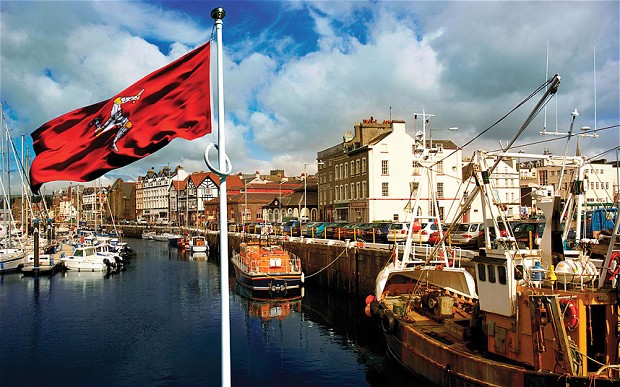
    An Isle of Man financier is facing disciplinary action after details of his role in a huge money-laundering scam emerged in a US court.

    Peter Bond, who denies wrongdoing and has not been charged by the US authorities, could be disqualified from company directorships following a legal move by the Financial Supervision Commission (FSC), the island’s regulator.

    He managed the personal fortune of Robert Brennan, a notorious American fraud ster who used the Isle of Man’s banking secrecy laws to stash a fortune away from his creditors.

    Brennan was sentenced to nine years in jail last year by a New Jersey federal court. Bond, who was unavailable for comment this weekend, gave evidence against him under a guarantee of immunity from prosecution.

    The two men met after Brennan’s high-profile broking firm, First Jersey Securities, collapsed in 1995, leaving him with debts of $75 million.

    Brennan held $4m of non-traceable bearer bonds, which he did not declare to creditors and detectives in the US. Instead, he placed this money with Bond, who invested it in the stock market via Bank of Scotland accounts and shell companies.

    The fortune quickly swelled to $20m. Brennan used the money to fund a lavish lifestyle, including gambling trips to Monaco and Sun City, a 450-foot yacht and several luxury homes.

    Bond, who lives in Douglas, the Isle of Man’s capital, told the court of an elaborate system of passwords and covert meetings, which Brennan devised to have cash delivered to him in hotel lobbies and homes.

    Brennan’s lawyers claimed Bond was an unreliable witness in the case, accusing him of involvement in laundering Russian money.

    But Bond rejected the allegations and insisted that he had not been aware that Brennan was defrauding creditors. He was backed by US prosecutors.

    John Apsden, head of the Isle of Man’s regulator, confirmed that a disqualification application was filed against Bond at the island’s High Court last week, but declined to comment further.

  • Making a Killing (The Big Issue)

    Making a Killing
    By Adrian Gatton
    The Big Issue
    19 August 2002

    Deposing dictators for £500 a week? Being a mercenary may about to become a legitimate job following Jack Straw’s proposals. But would private military companies be doing the government’s dirty work abroad?

  • Life for Kurd who alleged Turkish government drug scandal (The Big Issue)

    Life for Kurd who alleged Turkish government drug scandal
    By Adrian Gatton
    The Big Issue
    5 August 2002

    The British-based family of the jailed co-founder of the exile political group, Kurdish Parliament in Exile, last week vowed to fight a shock decision by a Dutch appeal court to increase his sentence from 20 years to life imprisonment.

    Huseyin Baybasin, a Kurd from Turkey, (pictured) has made a series of sensational allegations from his jail cell about Turkish government complicity in the £25-billion heroin trade. According to official estimates, 80 per cent of the heroin on Britain’s streets is trafficked via Turkey.

    Baybasin, who has been an outspoken critic of Turkish government corruption since 1989, was arrested in Holland in 1998 as simultaneous raids in seven countries netted members of the Baybasin extended family.

    In February 2001, Baybasin was convicted and sentenced by a Dutch court to 20 years for contract killings, kidnapping and drug trafficking. The case rested on 6,000 intercepted telephone conversations. During the appeal, rejected last week, the defence, backed up by a former Dutch military intelligence officer, pointed to “clear irregularities” in the recordings, arguing they had been tampered with. Judges in Amsterdam were unconvinced and, in an unusual move, increased the sentence to life.

    Baybasin’s claims have recently been published in a book, Trial By Silence, which is banned in Turkey. He describes links between mafia syndicates and the Turkish elite. This echoes British Customs and Excise’s concerns that Turkish drug gangs are protected by the Turkish state. He also exposes details of Turkey’s ‘dirty war’ against the Kurds.

    Baybasin, from the south-eastern border town of Lice, was drawn into the Turkish underworld after he sold black market cigarettes in Istanbul. A British court sentence him in 1984 for drug trafficking. He was returned to Turkey shortly afterwards and released.

    Baybasin’s lawyer, Adele van der Plas, said she would be taking the case to the Dutch Supreme Court. His family, who live in north London, are distressed that he is forbidden to speak to his young son in his native Kurdish language and to his mother, who speaks only Kurdish. Younger brother Mesud Baybasin said: “He is being silenced because of his revelations about the dirty war in Turkey.”

    Baybasin’s claims follow numerous allegations about the Turkish establishments links with organised crime syndicates. In 1996 a car crash near Istanbul sparked scandal when it emerged that the passengers were a top crime boss, a senior police commander, a beauty queen and an MP.

    Van der Plas said Dutch and Turkish prosecutors had collaborated on the case and added: “This is very political. He is an enemy of the Turkish state. This is a shameful day for Dutch law.”

    Claude Moraes, Labour MEP for London, who has had a long-standing interest in Kurdish affairs, said: “I am deeply concerned about the treatment of Mr Baybasin and I will be raising questions about this case in the European Parliament.”

  • Spearmint Rhino Clubs Investigation (Channel 4 News)

    Spearmint Rhino Clubs Investigation (Channel 4 News)


    Special Investigation
    Channel 4 News
    By Adrian Gatton
    9 June, 2002

    If you haven’t heard of Spearmint Rhino then Max Clifford hasn’t been doing his job. Rhino is the high class American strip club that you can trust your husband to, if you believe the hype – and women are invited too.

    The chain’s enjoyed astonishing success since the first club opened in the UK two years ago. Already there are 6 clubs: 3 in London and the south east, and others in Birmingham, Bournemouth and Harrogate. Another is due to open in Leeds.

    But doubts are growing about Rhino and its flamboyant boss John Gray. Adrian Gatton reports …

    Copies of this report can be ordered via the ITN Archive. The shot-list can also be viewed via the archive.

    ARCHIVE:
    International rights to this film are owned by Hayes-Gatton Productions. To purchase footage from this 12-min film please contact Adrian Gatton. There are also unbroadcast rushes available.